
|
|

GENERAL INFO: As kittens, Burmese are quite lively. They often seem clumsy when they attempt feats beyond their capabilities and land on their rears with solid little thumps. They will be playful well into adulthood. As Burmese grow, their high intelligence emerges and their own individual personalities start to unfold. They mature into charming, resolute executives who move in and take over a household, running it efficiently with those big eyes and avelvet paw. If encouraged, many Burmese converse with their humans, using soft, sweet voices (they are neither loud nor raucous). They are good with children, will tolerate the family dog, and if introduced to it at an early age as something pleasant, most will enjoy traveling in a car.
Burmese are extremely people-oriented; their personalities are almost dog-like in a tendency to shadow their owners and in a desire to give and receive affection. Many Burmese have delighted their "humans" by learning to retrieve. They love warm laps and caressing hands and enjoy cuddling up in bed either under the covers or on top of their favorite persons. They delight in helping to manage the house. Some of their favorite chores are assisting with paper work or reading (by sitting on top of the material), or going into cupboards (to demonstrate where things ought to be). Typically, Burmese are always with people. The females tend to request center stage and take an active role in ruling the household. The males prefer to supervise from the lap position, are more laid back and less opinionated. If emotionally slighted by their owner's obtuseness, Burmese may sulk, but, fortunately, not for long. Burmese often convert the most anti-cat person into a Burmese enthusiast. Be forewarned! They can be addictive, and like potato chips, you may find you cannot have just one. Many people find the complete Burmese experience is to have one of each sex or perhaps two (or more) colors.
Burmese should never be let outdoors as they are entirely too trusting and have little, if any, survival instinct. Their idea of survival is to turn their soulful eyes on you to attend to all their needs. This does not work for catching food, fighting off enemies or avoiding cars.
HEAD, EARS, and EYES:
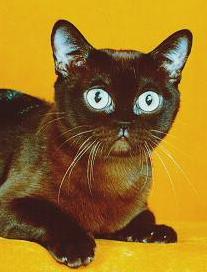
The head is pleasingly rounded without flat planes whether viewed from
the front or side. The face is full with considerable breadth between the
eyes and blends gently into a broad, well-developed short muzzle that maintains
the rounded contours of the head. In profile there is a visible nose break.
The chin is firmly rounded, reflecting a proper bite. The head sits on
a well-developed neck. The ears are medium in size, set well apart,
broad at the base and rounded at the tips. Tilting slightly
forward, the ears contribute
to an alert appearance. The eyes are large, set far apart, with rounded
aperture.
BODY: Medium in size, muscular in development, and presenting a compact appearance. Allowance to be made for larger size in males. An ample, rounded chest, with back level from shoulder to tail.
LEGS: Well proportioned to body.
PAWS: Round. Toes: five in front and four behind.
TAIL: Straight, medium in length.
COAT: fine, glossy, satin-like texture; short and very close lying.
COLORS: Burmese can be the following colors: sable, champaign, bue, and platnum.
HISTORY: The Burmese breed as we know it today was developed in the U.S. from a single cat, Wong Mau, who, as Dr. Rosemonde Peltz reports in the 1968 CFA Yearbook, was "unlike any other breed in the U.S. or Europe." Wong Mau was brought from the Orient to New Orleans by a sailor, and was given to Dr. Joseph G. Thompson of San Francisco in 1930. Wong Mau was described as "a rather small cat, fine boned, but with a more compact body than that of a Siamese, with shorter tail, a rounded, short-muzzled head, with greater width between rounded eyes." Her color was described as walnut-brown, with darker brown points.
This page was researched
by Sister Cats

View My Guestbook
Sign My Guestbook